One of the most common questions we answer at Forza Auto Studio is this:
"Should I get paint correction or ceramic coating — and does the order matter?"
The order matters enormously. Getting it wrong doesn't just produce a subpar result — it can permanently lock defects into your vehicle's paint under a coating that's designed to last for years.
Ceramic Coating and Paint Correction Are Not Competing Services
This is the single biggest misconception in the detailing industry.
Paint correction and ceramic coating are not alternatives. They are sequential steps in a complete paint protection process — and each one serves a fundamentally different purpose.
Paint correction improves the paint. It removes defects from the clear coat — swirl marks, scratches, water spot etching, holograms — to produce a surface that reflects light evenly and deeply.
Ceramic coating protects the paint. Once applied, it creates a semi-permanent protective layer over the corrected surface that resists UV degradation, contamination bonding, and surface marring.
Correction improves. Coating preserves. Neither one does the job of the other.
Why Paint Correction Must Come First
A ceramic coating is optically transparent. It does not obscure what's beneath it. In fact, the depth and gloss that a ceramic coating produces often makes surface defects more visible than they were before application.
If swirl marks are present on the paint when the coating is applied, those swirl marks will be visible through the coating. They will remain visible for the entire lifespan of the coating — which, in the case of a professionally applied product, could be three to five years or longer.
Removing a ceramic coating to correct the paint underneath is technically demanding and significantly more expensive than the alternative: correct the paint first, then coat it.
This is why at Forza Auto Studio, paint correction before ceramic coating is not a recommendation we make optionally. It's part of the process.
What Paint Correction Actually Does
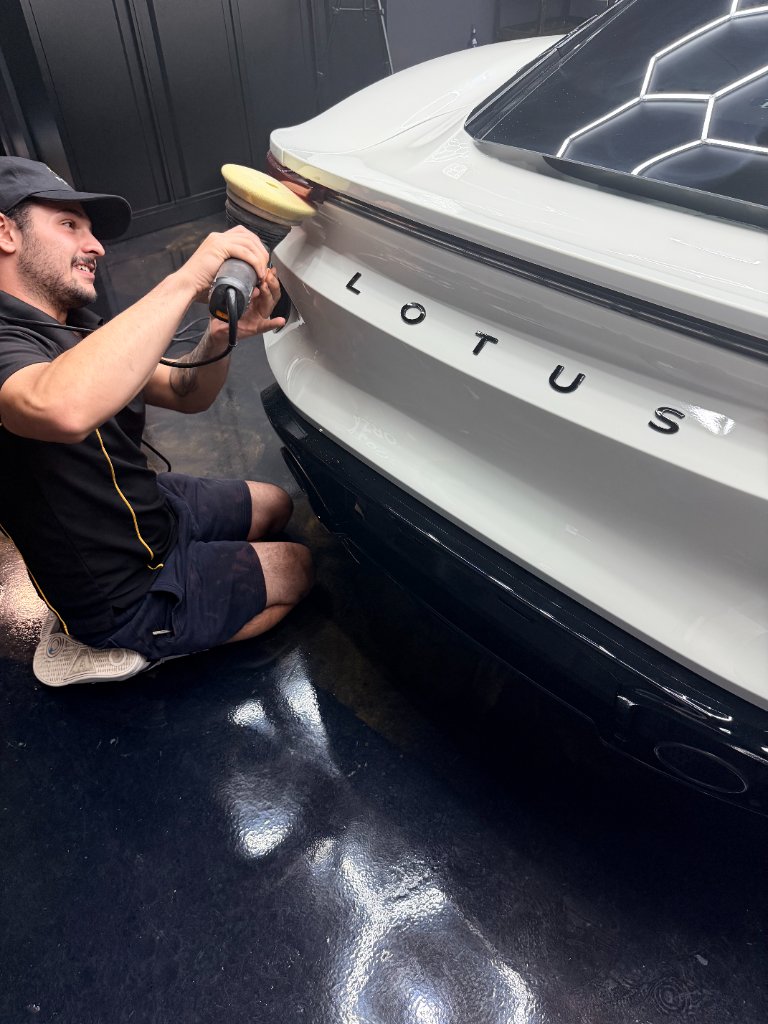
Paint correction is machine polishing performed by a trained professional using the correct compounds, pads, and equipment for the specific vehicle and paint system.
The process removes a microscopic layer of clear coat to eliminate the damaged portion where defects exist. The result is a levelled surface that reflects light as a flat mirror would — producing the depth, clarity, and gloss that new paint is supposed to deliver.
In the context of the full car detailing process in Canberra, paint correction is the foundational step. Everything that follows — including ceramic coating — is built on the surface quality that correction establishes.
What Ceramic Coating Actually Does
Once the paint has been corrected and the surface properly prepared, ceramic coating is applied panel by panel.
A professional-grade ceramic coating chemically bonds to the clear coat and creates a hard, hydrophobic protective layer that:
- Repels water and prevents contamination bonding
- Blocks UV radiation and slows oxidation
- Resists light swirling from washing
- Produces sustained gloss without ongoing waxing
- Makes the vehicle significantly easier to maintain
The key point is that ceramic coating locks in the condition of the paint beneath it. Correct first. Then lock in a perfect surface.
The Complete Paint Protection Process at Forza Auto Studio
Stage 1: Safe Wash and Decontamination
The vehicle is washed using safe contact techniques and chemically decontaminated to remove bonded iron particles, industrial fallout, and road contamination. Clay bar treatment follows where required.
Contaminated paint cannot be correctly polished — decontamination is non-negotiable.
Stage 2: Paint Thickness Measurement and Defect Assessment
Paint thickness readings are taken across all panels. This data determines how aggressively the paint can be corrected safely. Defects are assessed under high-intensity lighting to map their type and density across each panel.
Stage 3: Paint Correction
Machine polishing is performed panel by panel using the correct compound and pad combination for the paint system. Defects — swirl marks, scratches, holograms, water spot etching — are removed systematically.
Depending on the vehicle's condition, this stage may involve single-stage enhancement, two-stage correction, or multi-stage refinement.
Stage 4: Panel Preparation
Once correction is complete, all polishing oils and residues are removed using a panel preparation solution. Any residue left on the surface will interfere with ceramic coating bonding.
Stage 5: Ceramic Coating Application
Coating is applied panel by panel in a controlled, dust-free environment. Each panel is levelled to ensure even, streak-free coverage. The vehicle then cures properly before delivery.
Stage 6: Post-Care Instructions
Every client receives specific maintenance guidance — because how you wash a coated car directly affects how long the coating performs.
How To Choose The Right Detailing Package in Canberra
Not every vehicle is in the same condition, and not every owner has the same goals. The right paint protection process depends on:
Current Paint Condition — A vehicle with heavy swirl marks, scratches, and contamination requires more correction time than one with light surface defects.
Vehicle Value and Purpose — High-value vehicles, prestige marques, and newly purchased cars typically benefit from multi-stage correction and premium coating tiers.
Desired Longevity — Entry-level coatings provide shorter protection windows. Premium multi-layer systems extend protection significantly.
Maintenance Commitment — A ceramic coating still requires correct washing technique. Owners who maintain their vehicles with appropriate methods will see coating performance last longer.
At Forza Auto Studio, we assess every vehicle individually and recommend the correction and coating combination that matches the car's actual condition — not a package selected from a menu.
Frequently Asked Questions
Do all cars need paint correction before ceramic coating?
Most do. Even new vehicles frequently have swirl marks induced by dealership pre-delivery polishing or transport. A paint inspection determines the level of correction required.
Can I skip paint correction if my car looks fine?
Paint defects are often invisible in overcast outdoor light and only become apparent under direct sunlight or workshop lighting. Coating over defects locks them in.
How long does the full process take?
A complete correction and ceramic coating service at Forza Auto Studio typically takes between two and four days depending on vehicle size, paint condition, and correction level required.
What is the difference between polishing and paint correction?
Polishing in the traditional sense often refers to applying a product that fills or temporarily hides defects. Paint correction is the physical removal of those defects through machine polishing with appropriate compounds. One masks. The other corrects.
The Right Sequence. The Right Result.
At Forza Auto Studio, we don't cut corners on preparation. Ceramic coating applied over uncorrected paint is a shortcut that delivers a permanent compromise.
Our process is correct first, protect second — every time.
Schedule a paint correction and receive complimentary paint, glass & wheel protection — limited availability.
Forza Auto Studio operates on capped weekly capacity. This offer is extended to clients who are serious about protecting their vehicle properly. Contact us to discuss availability and what your vehicle actually needs.