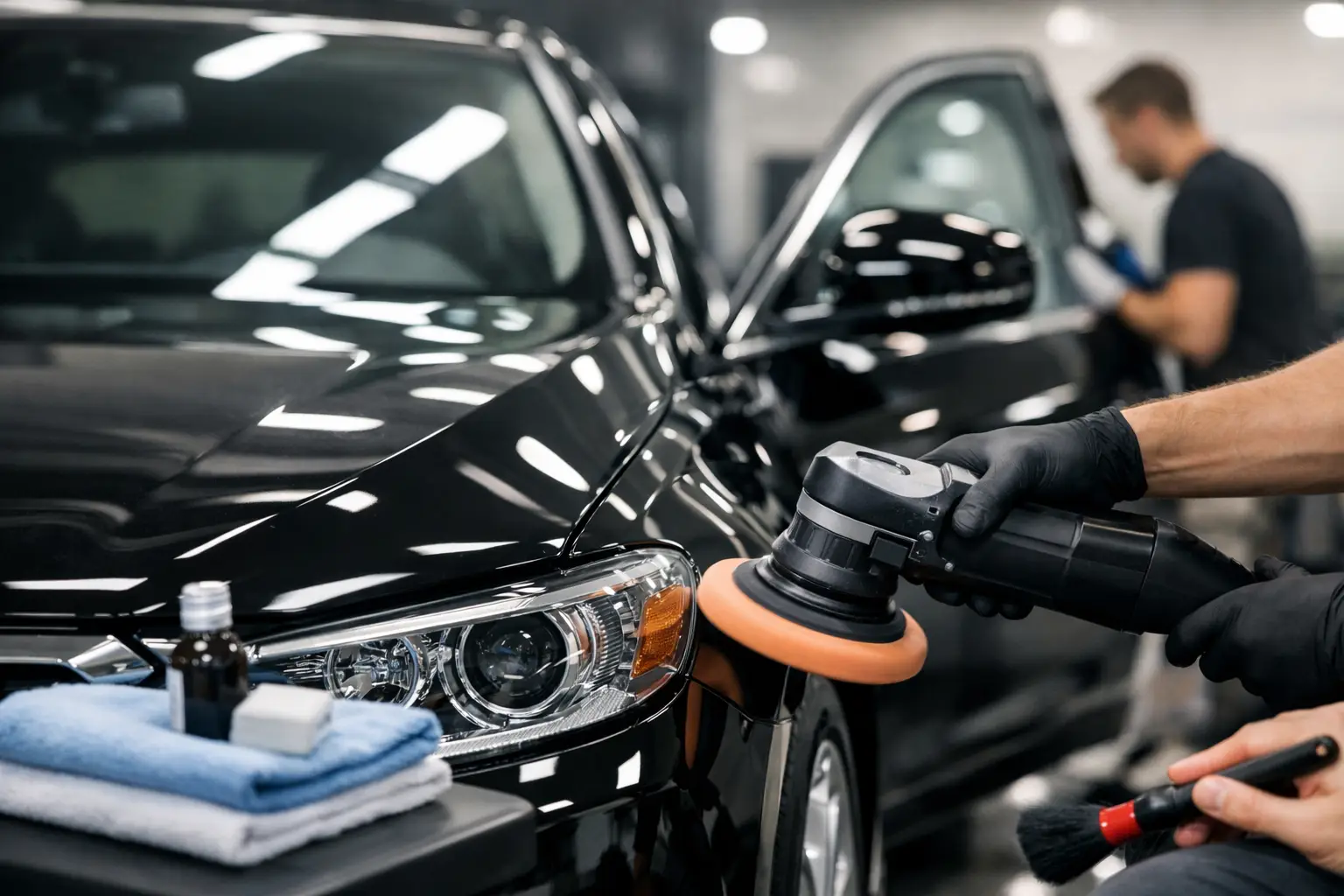
WHAT PROPER CAR DETAILING SHOULD ACHIEVE
A vehicle can appear clean while still carrying the effects of poor washing, environmental contamination and everyday use.
Under Canberra’s harsh sunlight, swirl marks, water spotting, oxidation and dulled paint become far more noticeable than they do under overcast skies or showroom lighting. Reflections lose their sharpness, darker colours begin to look flat and metallic finishes lose the depth they were designed to have. Many owners assume the vehicle simply looks “older,” when in reality the paint has gradually accumulated defects that are often correctable.
Professional car detailing isn’t simply about making a vehicle look cleaner for a few days. Done properly, it’s a structured process of inspecting, cleaning, refining and protecting every surface to preserve both its appearance and long-term condition.
At Forza Auto Studio, every recommendation begins with understanding the vehicle itself. Two vehicles of the same age, colour and model can require completely different approaches depending on how they’ve been washed, where they’ve been stored, whether they’ve been repainted and what level of preservation the owner is hoping to achieve.
The objective isn’t to perform the most work possible. It’s to recommend the work the vehicle genuinely needs.
THE VEHICLE DETERMINES THE PROCESS
One of the biggest misconceptions about professional detailing is that every vehicle follows the same process.
It doesn’t.
A brand-new vehicle may arrive with dealership wash marks, transport contamination, adhesive residue or poorly applied protection despite having only delivery kilometres. A daily driver may have excellent paint hidden beneath months of accumulated road film. A cherished weekend car may have extremely soft paint that requires a conservative polishing approach, while an older enthusiast vehicle may have already undergone previous correction work and simply not have unnecessary clear coat available to remove.
This is why professional detailing should never begin by selecting a package.
Instead, it begins with assessing the vehicle’s current condition.
Paint condition, previous repairs, paint thickness, defect severity, intended use and owner expectations all influence the correct recommendation. Sometimes that recommendation is extensive paint correction followed by ceramic coating. Other times, a comprehensive deep clean and careful protection are all that’s required.
At Forza Auto Studio, every recommendation is based on what’s right for the vehicle—not what creates the biggest invoice.
WHY PROFESSIONAL INSPECTION MATTERS Before a polishing machine is switched on or a ceramic coating bottle is opened, the vehicle should be carefully inspected.
Inspection lighting reveals defects that normal daylight often hides. Swirl marks, sanding marks, holograms, water spotting and previous repair work all become much easier to identify under controlled lighting conditions.
Where appropriate, paint thickness readings also help determine how safely correction can be performed. Every polishing process removes a microscopic amount of clear coat. Understanding how much material is available helps guide responsible decisions throughout the correction process.
Inspection also provides an opportunity to identify areas that require a different approach.
Plastic trims, piano black finishes, gloss black pillars, carbon fibre components and freshly repainted panels can all behave differently during polishing.
Rather than assuming every panel should receive identical treatment, professional detailing adapts the process to suit the vehicle.
A DEEP CLEAN REVEALS WHAT IS BENEATH Before paint can be corrected or protected, it needs to be genuinely clean.
A routine wash removes loose dirt.
A professional deep clean removes contamination that has bonded itself to the vehicle over weeks, months or even years.
Iron fallout from brake dust embeds itself into paint and wheels. Tar accumulates behind wheel arches and lower panels. Road film dulls gloss while mineral deposits gradually stain paint and glass. Insects, tree sap and industrial fallout all contribute to contamination that ordinary shampoo cannot remove.
Professional detailing addresses these contaminants individually.
Wheel faces, barrels and arches receive dedicated attention because brake dust behaves differently to contamination found on painted panels. Door shuts, fuel fillers, grilles, badges and lower body sections are cleaned thoroughly before the paintwork itself is assessed.
Only once this contamination has been removed can the true condition of the paint be seen.
Skipping this stage doesn’t save time.
It simply compromises everything that follows.
CHEMICAL & MECHANICAL DECONTAMINATION Many contaminants cannot be removed through washing alone.
Chemical decontamination targets contaminants such as iron fallout, mineral deposits, tar and adhesive residue using specialised products designed for each type of contamination.
Mechanical decontamination, commonly performed using a clay bar or clay mitt, removes remaining bonded particles that continue to cling to the paint after chemical treatment.
When performed correctly, the paint surface becomes noticeably smoother.
More importantly, polishing pads are able to work directly against the paint rather than dragging contamination across the surface.
This creates a cleaner foundation for paint correction while reducing unnecessary marring during the polishing process.
The objective isn’t simply to produce a smooth finish.
It’s to prepare the paint correctly before refinement begins.
PAINT CORRECTION IS CONTROLLED REFINEMENT Paint correction is often misunderstood.
Contrary to popular belief, polishing doesn’t fill scratches or temporarily disguise defects.
It carefully refines the clear coat itself.
Swirl marks and light scratches are tiny imperfections within the clear coat that scatter incoming light. Machine polishing carefully levels the surrounding surface so reflections become sharper and more consistent.
The level of correction depends entirely on the vehicle.
Some cars benefit significantly from a single-stage paint enhancement that restores gloss while preserving maximum paint thickness.
Others require a more involved multi-stage correction to reduce heavier swirls, oxidation, haze and deeper defects.
Every polishing combination—including machine choice, pad selection, polish and polishing technique—is chosen according to the paint system being worked on.
There is no universal combination that suits every vehicle.
Professional correction is a measured process based on inspection rather than assumption.
WHY EVERY SCRATCH SHOULDN’T BE REMOVED One of the least discussed aspects of paint correction is knowing when to stop.
Not every defect should be removed completely.
Some scratches extend beyond the clear coat. Others may have already been polished repeatedly throughout the vehicle’s life.
Removing every visible defect regardless of paint thickness can compromise the long-term integrity of the finish.
In many situations, reducing the visibility of a scratch while preserving healthy clear coat is the more responsible decision.
This philosophy often surprises owners.
Many expect professionals to pursue perfect paint at any cost.
Long-term preservation, however, is rarely achieved by removing as much material as possible.
It’s achieved by removing only what’s necessary.
At Forza Auto Studio, responsible refinement always takes priority over unrealistic perfection.
CERAMIC COATING PROTECTS THE FINISH YOU PREPARE Once paint has been properly prepared, ceramic coating helps preserve the result.
Modern ceramic coatings form a durable protective layer over prepared paintwork, making routine washing easier while increasing resistance to UV exposure, environmental contamination and many common chemicals encountered during normal driving.
What ceramic coating doesn’t do is make paint indestructible.
It won’t prevent stone chips.
It won’t stop every scratch.
It won’t eliminate washing.
It also won’t hide defects beneath the coating.
Any swirl marks, sanding marks or polishing defects left before application remain visible once the coating cures.
Preparation therefore remains the single most important stage of the entire coating process.
A premium coating cannot compensate for poor preparation.
It simply protects whatever finish exists beneath it.
CERAMIC COATING OR TRADITIONAL PROTECTION? Traditional waxes and synthetic sealants continue to have their place.
Many enthusiasts enjoy regularly applying wax to their vehicles and appreciate the appearance these products can produce.
For some owners, this remains a perfectly sensible option.
Ceramic coating becomes increasingly attractive when the objective shifts towards long-term preservation and simplified maintenance.
Daily drivers, prestige vehicles and enthusiast cars exposed to Canberra’s varying weather conditions all benefit from protection that remains effective between routine maintenance appointments.
The correct recommendation depends on ownership habits.
Someone who enjoys waxing every few months may not require a long-term ceramic coating.
Someone seeking years of consistent protection with structured maintenance almost certainly will.
There isn’t a universal answer.
There is only the right solution for the individual owner.
PROTECTION STILL REQUIRES MAINTENANCE One of the biggest myths surrounding ceramic coating is that maintenance becomes unnecessary.
The opposite is true.
A coated vehicle is easier to maintain because contamination releases more readily during washing.
It still needs to be washed correctly.
Road film, mineral deposits and environmental contamination continue accumulating over time. Poor washing techniques can still introduce swirl marks. Neglect can gradually reduce gloss and alter water behaviour even while the coating itself remains intact.
Professional maintenance keeps contamination under control before it becomes a larger problem.
Rather than waiting until another major correction becomes necessary, regular maintenance preserves the work that’s already been completed.
This is the philosophy behind Forza Auto Studio’s Preservation Programme.
It’s designed to maintain the finish—not repeatedly restore it.
CHOOSING THE RIGHT DETAILING SERVICE Choosing a detailing studio shouldn’t begin with comparing package prices.
It should begin with understanding how the vehicle will be assessed.
Ask whether inspection lighting is used.
Ask whether paint thickness is considered before correction.
Ask what level of defect removal is realistically achievable.
Ask how the vehicle should be maintained once the work is complete.
Professional recommendations are rarely identical because no two vehicles arrive in identical condition.
Be cautious of promises of perfect paint without inspection.
Every vehicle has a different history, and responsible professionals recognise that before recommending any service.
A considered inspection almost always produces a better long-term outcome than selecting a package from a menu.
PRESERVATION OVER PERFECTION Professional detailing is about far more than producing immediate gloss.
It’s about understanding the vehicle, respecting its condition and making informed decisions that preserve it for years to come.
At Forza Auto Studio, every vehicle is worked on individually in a controlled studio environment. Recommendations are based on inspection, preparation and responsible refinement rather than assumptions or unnecessary upselling.
Whether the vehicle is a brand-new purchase, a cherished weekend car or a daily driver intended to be kept for many years, the goal remains the same: preserve the finish responsibly so it continues to present at its best long after it leaves the studio.
The process always begins with understanding the vehicle. Once its condition is properly assessed, the right combination of cleaning, correction, protection and maintenance becomes clear.
Request an inspection https://forzaautostudio.com/contact