

A car paint decontamination service addresses the contamination that remains after a thorough wash - the particles and deposits bonded to paint, glass, wheels and exterior trim. A vehicle can look clean from a few metres away yet still feel rough to the touch, show dullness in direct light, or carry contaminants that interfere with paint correction and ceramic coating preparation.
For owners who value paint clarity and long-term vehicle preservation, decontamination is not an optional cosmetic extra. It is a controlled preparation process that creates a genuinely clean surface, allowing the condition of the paintwork to be assessed accurately and any next step to perform as intended.
Why washing alone is not enough
Routine washing removes loose road film, dust, mud and much of the surface grime collected through daily driving. It does not reliably remove embedded industrial fallout, brake dust particles, tar, tree residue, mineral deposits or overspray. These contaminants can bond to the clear coat over time, particularly on vehicles regularly parked outdoors or driven through urban and industrial areas.
Canberra conditions can be demanding in their own way. Dry dust, seasonal pollen, road grime, tree sap and mineral-heavy water marks can all affect exterior surfaces. Dark paint often reveals the issue first, but every paint colour is susceptible.
The usual sign is a gritty or uneven finish when a clean hand is gently passed across the paint. That texture is not always visible, and it should not be tested on a dirty vehicle. Once the vehicle has been safely washed, it becomes easier to distinguish bonded contamination from paint defects such as swirl marks, scratches, oxidation and etching.
What a car paint decontamination service removes
The exact process depends on the vehicle and its history. A well-maintained weekend car may need a light chemical decontamination, while a daily driver that has spent years outside may require more involved work. The aim is always to remove contamination safely, not to use unnecessary abrasion.
Ferrous fallout and embedded metal particles
Fine metallic particles from brake systems, rail transport, industrial areas and general road use can settle into the clear coat and wheel finishes. Over time, these particles oxidise and bond to the surface. On light-coloured vehicles, they may appear as small orange or brown specks; on darker paint, they are often noticed through texture rather than colour.
A specialist iron remover reacts with these particles so they can be rinsed away with minimal physical contact. This is particularly valuable around lower doors, rear panels and wheels, where contamination often accumulates. It is a chemical process, but it still requires controlled application, suitable dwell time and thorough rinsing.
Tar, adhesive and road film
Fresh road tar can be unsightly, but the greater issue is often the residue left behind after it has dried and hardened. Tar removers and adhesive removers are selected and used carefully to dissolve these deposits without aggressively scrubbing the paint.
This matters because rubbing hardened tar with a wash mitt or towel can introduce fresh marring. On a vehicle being prepared for paint correction, avoiding additional defects is as important as removing the contamination itself.
Mineral deposits and water spotting
Water spots are not all the same. Some are simple mineral deposits sitting on the surface and can be removed with appropriate chemical treatment. Others have etched into the clear coat after heat and time concentrated the minerals on the panel. In that case, decontamination may remove the deposit but not the mark beneath it.
This distinction is why inspection matters. Etched water spots may require paint correction to improve their appearance, while deeper damage may not be fully removable without taking more clear coat than is sensible. A preservation-led approach considers the available paint thickness and the result that can be achieved responsibly.
Organic contamination and overspray
Tree sap, insect residue, bird droppings and pollen can bond to paint when left exposed to heat. These materials should be addressed carefully and promptly, as some can stain or etch the clear coat. Overspray from nearby paintwork or construction activity may also leave a rough finish that a normal wash will not remove.
Where contamination remains after chemical treatment, a clay bar or synthetic clay media may be used with suitable lubrication. This process can leave light marring on sensitive paint, so it is not a default step for every vehicle. When it is needed, it is often followed by paint correction or at least a refinement process to restore gloss and clarity.
The difference between decontamination and paint correction
Decontamination cleans the surface. Paint correction refines the surface.
That difference is easy to overlook because both can make a vehicle look better. Removing bonded fallout and road film allows light to reflect more evenly, so the paint can immediately appear cleaner and glossier. However, decontamination does not remove swirl marks, random scratches, oxidation, deeper water-spot etching or other defects within the clear coat.
Paint correction uses measured machine polishing techniques to reduce those defects and restore clarity, depth and gloss. It should only begin once the paintwork is properly cleaned and decontaminated. Polishing over bonded contamination can compromise the finish and reduce the control a specialist needs during the correction process.
For some vehicles, especially newer cars with sound paint and light wash marring, decontamination followed by a paint enhancement may be the appropriate balance. For an older vehicle with significant defects, a multi-stage paint correction may offer a more meaningful improvement. Neither option should be prescribed before the vehicle has been inspected under proper lighting.
Why preparation matters before ceramic coating
A ceramic coating needs a meticulously prepared surface to bond effectively and present properly. Any remaining contamination can affect surface uniformity, while unaddressed swirl marks and scratches can be visually amplified once the coating adds gloss.
This does not mean every ceramic coating project requires extensive correction. Some owners want to preserve a new vehicle with only limited refinement, while others want the paint brought to a higher standard first. The right approach depends on the vehicle’s condition, its intended use and the owner’s expectations.
A proper preparation sequence generally includes a safe wash, chemical decontamination, targeted treatment for tar or mineral deposits, mechanical decontamination only where appropriate, and a paint assessment. If correction is planned, panel condition and paint response guide the polishing approach. Before coating, the surface is refined and panel-wiped so it is free from polishing oils and residue.
The benefit is not simply a more impressive delivery-day finish. Correct preparation supports easier ongoing maintenance because contamination is less likely to build on an uneven or poorly prepared surface. It also provides a clean baseline for a coating maintenance routine.
When should your vehicle be decontaminated?
There is no single calendar interval that suits every car. A garaged enthusiast vehicle with careful maintenance may need less frequent decontamination than a daily driver parked outside near trees, construction activity or busy roads.
Signs that it may be time include rough paint after washing, persistent dark specks around lower panels, tar behind the wheel arches, reduced gloss despite regular cleaning, or water marks that do not respond to a safe wash. It is also appropriate before paint correction, ceramic coating application, or a comprehensive exterior deep clean intended to reset the vehicle’s condition.
For a coated vehicle, decontamination should be approached with care. The goal is to remove bonded contamination without needlessly reducing coating performance. Product selection, wash technique and mechanical contact should be adjusted to the coating’s condition rather than handled as a standardised package.
What a careful service looks like
A worthwhile car paint decontamination service is methodical rather than hurried. The vehicle is assessed first, including its paint condition, contamination level, existing protection and areas that require particular care. Soft paint, ageing single-stage finishes, matte surfaces, vinyl, polished metal and delicate trim each call for different decisions.
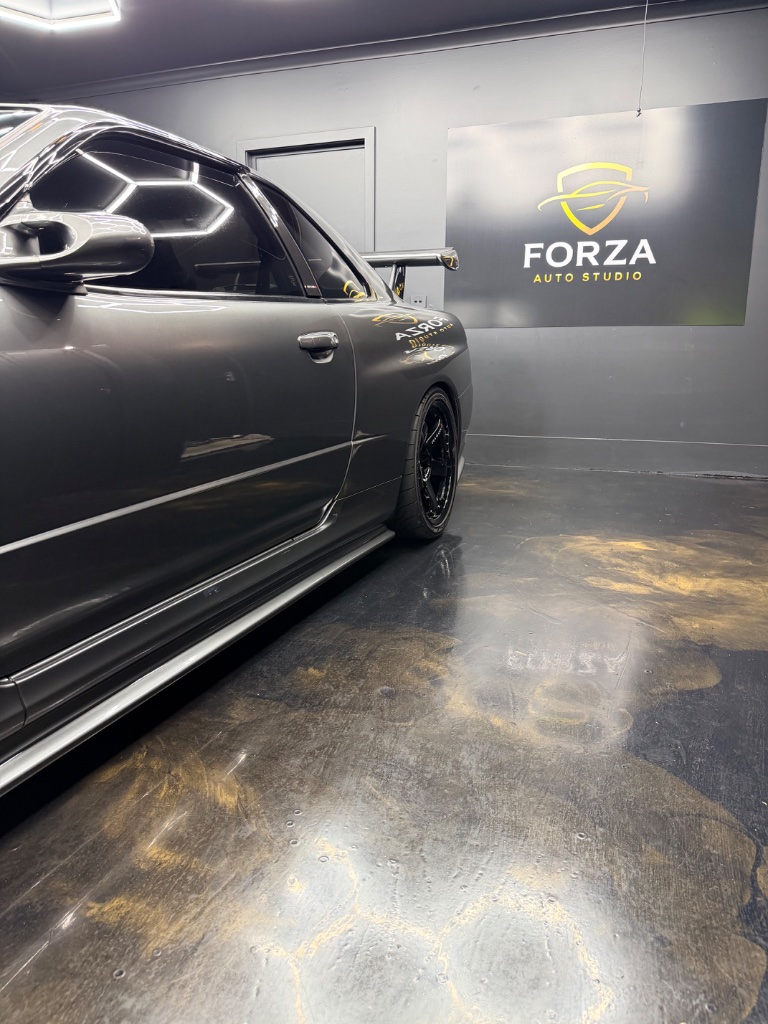
At Forza Auto Studio, this inspection-led approach also helps separate what can be cleaned from what needs correction, and what should simply be preserved. PJ works on one vehicle at a time, allowing the process to follow the condition of the car rather than a fixed sequence applied to every booking.
Decontamination is often invisible work: the difference is felt in the smoothness of the paint and seen in the cleaner, sharper reflection that follows. Yet it is one of the foundations of a properly prepared vehicle. If your paint no longer feels as clean as it looks, a careful inspection is the sensible place to start.